
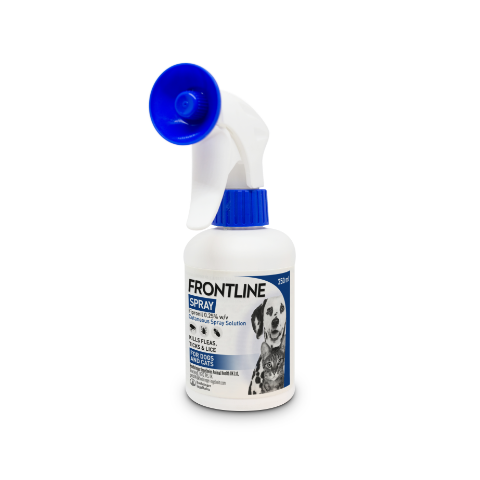
Why Frontline Spray (and What It Can and Can’t Do)
As a vet, I’ve seen many rescued kittens arrive with fleas, often without the new owner realizing until the
infestation spreads. I’ve also seen puppies from breeders or shelters already carrying fleas. Inspect your pet
for fleas as soon as you bring them home. If you’re unsure how, read my
guide on recognizing fleas.


Frontline Spray: Early Use and Limitations
Frontline Spray is one of the few over-the-counter options that lets you intervene early.
According to the manufacturer, it can be used in puppies and kittens from 2 days of age.
However, it does not eliminate every flea instantly, and results are not immediate.
It is less powerful than veterinary prescription flea treatments typically used for older animals.
Prescription products are often more potent, last longer, and target more parasite life stages.
Even if you treat with Frontline Spray, you must follow a thorough protocol to fully break the flea life cycle.
Frontline Spray 250ml
Start creating Verdict in seconds, and convert more of your visitors into leads.
7.5
Our Score
Pros
- Works from 2 days old
- Safe to use when nothing else is available
- Affordable
- Easy to apply
Cons
- Not as strong as Prescription Products
- Takes 24 hours to start working

Our Pick
Frontline Spray – 250ml
£29.99
For The Treatment And Prevention Of Flea And Tick Infestations In Cats And Dogs, And As Part Of A Treatment Strategy For Flea Allergy Dermatitis In Cats And Dogs. The Product Is Active Against Ixodes Spp. Including Ixodes Ricinis, Important As A Vector Of Lyme Disease. The Product Controls Infestations With Trichodectes Which Can Bite Lice On Dogs And Felicola Subrostratus Lice Which Bite Cats.
How to Use Frontline Spray Safely and Effectively
- 1
Get Ready
- 2
Apply
- 3
Dry
- 4
Repeat
Get Ready
- Choose a quiet, well-ventilated space.
- Wear gloves to avoid skin contact.
- Keep your pet calm and secure (wrap gently in a towel if needed).
Application Technique
- Hold the bottle upright.
- Part the hair and spray toward the skin.
- Cover neck, sides, back, belly, legs, and underarms.
- For the head and eyes, spray onto a gloved hand, then gently work into the fur.
Let It Dry
- Allow the spray to air-dry — do not towel-dry.
- Prevent grooming until fully dry.
Repeat as Needed
- If dealing with an active infestation, repeat treatment according to the label (usually every 2–4 weeks).
- Combine with environmental control — cleaning, home, and yard treatments — to prevent re-infestation.
⚠️ Safety Notes & Best Practices
- Avoid overuse: Stick to the recommended dose—don’t exceed guidelines.
- Eyes, nose, and mouth: Avoid spraying near these sensitive areas.
- Age consideration: Because stronger prescription treatments are reserved for older animals, understand that Frontline Spray may not be as effective in very young pets.
- Use as part of a plan: To truly defeat fleas, you must also treat your home, yard, and any other pets.
- Monitor your pet: Always watch for signs of irritation or reactions, especially in very young or sick animals.
Frontline Spray — Frequently Asked Questions
According to the manufacturer, Frontline Spray is licensed for puppies and kittens from 2 days old.
Use exactly as directed on the label and consult your vet if your pet is unwell, pregnant, or underweight.
It starts killing adult fleas after application, but visible results are not instantaneous.
It targets adults on the pet; eggs, larvae, and pupae in the environment require home and yard treatment to break the life cycle.
Follow the label. During active infestations many protocols use every 2–4 weeks.
Frequency depends on species, weight, and infestation pressure. Do not exceed label directions.
Allow the coat to air-dry fully. Avoid bathing or swimming for a period specified on the label
to maintain efficacy. For very young animals, ask your vet before bathing.
Do not mix products without veterinary advice. Some combinations are unsafe,
especially for cats. A vet can pair environmental control with an age-appropriate prescription when needed.
Emerging adults from pupae in carpets and bedding can jump onto treated pets for weeks.
Keep vacuuming, wash bedding hot, use environmental sprays with an IGR, and treat all pets in the home.
Conclusion
Frontline Spray is a valuable first-line tool in managing flea infestations,
particularly for puppies and kittens too young for many other treatments.
While it helps reduce parasite load early on, it should not be seen as a complete solution.
The spray is less potent than veterinary prescription products typically used in older pets,
but its main advantage lies in allowing early, safe intervention before stronger medications become suitable.
For the best protection, combine Frontline Spray with a comprehensive, step-by-step flea control plan
that includes home cleaning and yard management. With consistency and vigilance,
you can achieve a flea-free environment and keep your pet healthy and comfortable.
Tip: Always read and follow the manufacturer’s instructions when applying flea treatments,
and consult your vet if your pet’s infestation persists.
For the best results, combine Frontline Spray with a full home and yard flea control plan.
By taking a proactive, multi-step approach, you’ll give your new companion a healthy, comfortable start while
protecting your home from infestation.
Tip: Brush your puppy or kitten 2–3 times daily with a flea comb
to remove fleas and eggs, supporting any treatment you use.